It is a team you will never see sitting in the office: five AI colleagues, each with their own tasks. Part of their work happens on its own, while I sleep, sit in a meeting or am busy with something else. With the rest, they help as soon as I need them.
Some people call a setup like this an AI OS or a Claude OS: an operating system for your business. Just as Windows is the layer between you and your computer, this sits between you and your business. You ask for something in plain language, and underneath, the system searches, connects and processes the rest. It is not a package you buy, and not off-the-shelf software you have to bend your way of working to. You build it around AI the way your business works and the way your customers want it: what it knows about your business, which systems it can use, what it can do and what happens on its own.
I am building mine step by step. Today it counts 35 skills, a shared memory and a handful of tasks that run every night, every morning or every minute. A technical diagram of that means little to most people. So I would rather introduce you to the team.
What does a team like this need?
An AI team is only as good as what you give it. There are four building blocks, and they build on each other, in this order:
- Context: what it already knows. Who we are, how we write, which customers and projects we have, which agreements we follow. Without context, Claude answers like a stranger you just met.
- Connections: which systems it can use. Email, calendar, projects, time tracking, accounting. Without connections, you keep copying and pasting.
- Skills: what it can do. Fixed ways of working that you write down once, so Claude carries them out the same way every time. Drafting a quote, scheduling a meeting, preparing the monthly invoices.
- Rhythm: what happens on its own. Tasks that run at a set moment, even when your laptop is closed.
For a business, I add two more: a memory the whole team shares, and rules that are enforced, so nothing goes wrong. More on that below.
Meet the team
My 35 skills naturally fall into a few roles. Each colleague does part of the work on their own, and helps with the rest when I need them. The examples come from our own systems, but the principle works just as well with other software.
The analyst
The project lead
The office manager
The office manager only works on request. Not every colleague needs to be working all the time. That is exactly the point: for each task, you decide what may happen on its own and where you give the go-ahead yourself.
Sales
The bookkeeper
Behind these five, there are two more colleagues. A marketer writes our blog articles and website copy in our tone, in Dutch and English, and publishes them with everything that goes with it. This article is one of them: they wrote the first draft, I polished it. You can read how that works in managing your website with AI. And a networker prepares our weekly networking meeting.
One memory for the whole team
What turns separate helpers into a team is that they work from the same source. Every email, every meeting report, every phone call, every task and every project document ends up in one shared memory. Searchable, and linked to the right customer and the right project.
That changes more than you would think. A colleague who wants to know what was agreed with a customer no longer has to ask me. They ask the system, and it often knows better than I do, because it forgets nothing and tells you where it was said. How we get conversations like that into the memory automatically, you can read in the report that never came.
In doubt? Then it asks me
A team that works independently needs clear rules. In my system, there are a few we never deviate from:
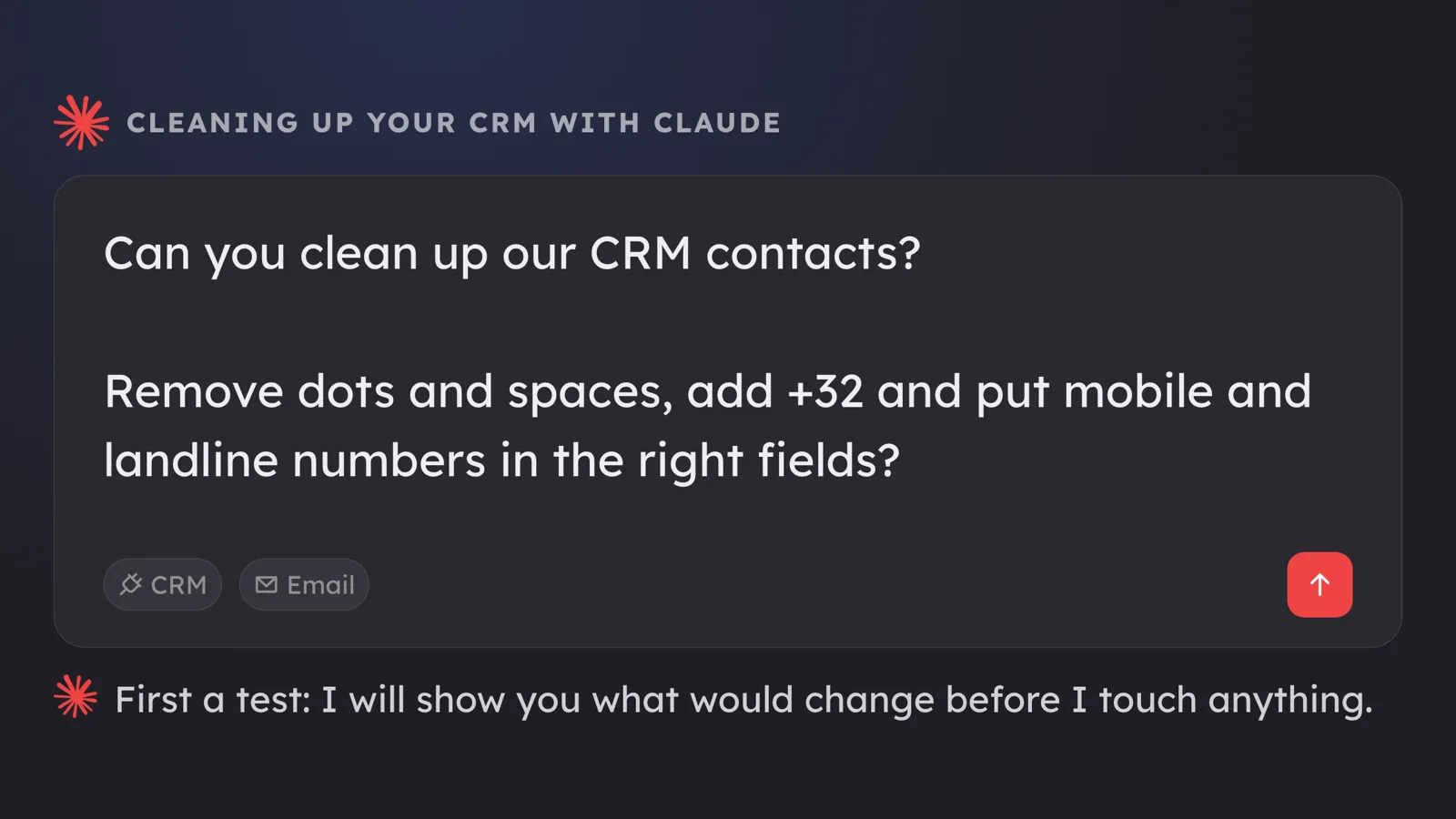
- First a proposal, then action. A meeting, a task or a change in our CRM is shown first. Only after my approval does it happen.
- Emails are drafted, never sent. I read and send them myself. That way a mistake stays a reading mistake, not a customer mistake.
- When in doubt, it asks. If the system is not sure which project an email belongs to, it waits and asks me.
- Checks run automatically. Every text is checked against our writing style on its own, before I even read it. And tracked hours can never overlap: the system simply refuses.
Personal, or for your whole business?
Many examples you find online are personal. Someone builds an AI assistant for themselves, gives it every permission and lets it run. That is a good start, but a business needs more:
- A memory that is shared, so not just I, but my colleagues benefit from it too.
- Skills everyone gets. When I improve a way of working, the whole team gets that improvement.
- Permission as the default. Not everything may happen on its own. You decide per task what the system may do by itself.
- Secrets in one safe place. Passwords and keys live in a password vault, never in a file or an instruction.
Which data an AI colleague may see and which not, you can read in not everyone needs to see everything.
That is also why I talk about colleagues, and not about an assistant. They don't just work for me, but for everyone at Sevendays. Whoever follows up a customer, starts a project or writes a quote, relies on the same AI colleagues and the same memory.
I wrote earlier about the difference between AI for yourself and AI for your business in Claude for yourself, or for your whole company. This article is that idea in practice.
Are you then locked into Claude?
No. Our AI colleagues run on Claude today, but most of what they know and can do doesn't belong to Claude. It belongs to you.
- The skills and rules are plain text files. Another AI model can read and follow them just as well.
- The connections run on an open standard that other AI tools support too. Email, calendar and projects stay reachable, whichever model is asking.
- The memory lives on our own server. Any tool we give access to can search it.
That is not theory. Our system already runs models from five different providers side by side, each for what it does best: writing text, doing research or transcribing conversations.
Not everything moves over one to one, but what matters stays yours: your ways of working, your rules and your data. The model underneath is replaceable, and that is how it should be.
How do you get started?
Not with 35 skills. My system grew one task at a time. Start with one question: what did you do three times this week, what felt like copying and pasting, or which task made you think "I really don't want to do this this way ever again"? That is your first skill.
Then stick to the order: context first, then connections, then skills, and only at the end what may run on its own. A task that runs every night without Claude knowing your business mostly creates work to fix.
And expect a small dip. The first weeks you are slower, because you are explaining things you used to just do yourself. After that it turns around: what you explain well once, you never have to explain again.
Want to know which colleagues your team needs first? At Sevendays we build this for other businesses too, connected to the systems you already use. Feel free to ask your question below.