 Claude
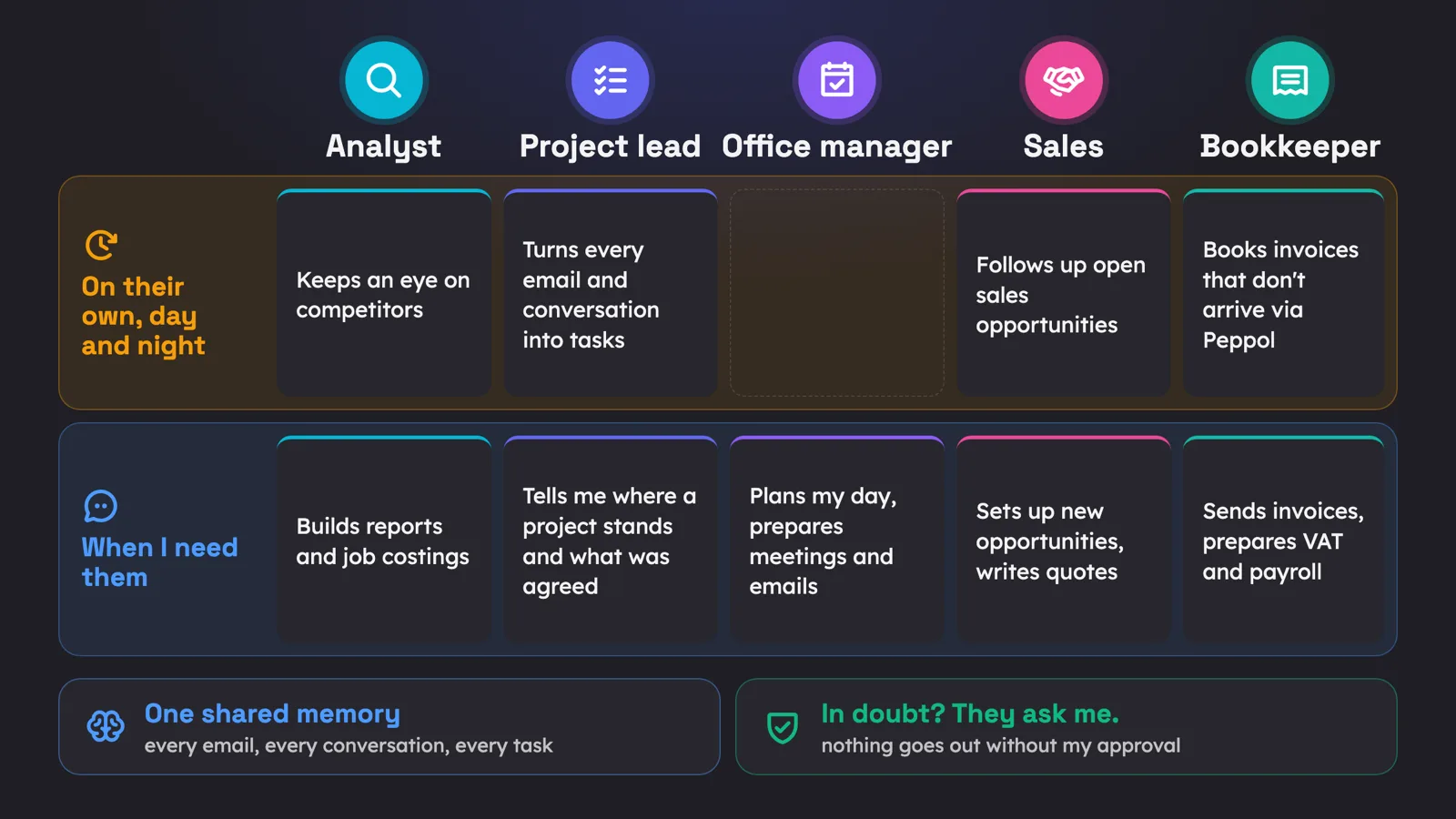
- Open quote €25,000 (6 May)
- Email from Jan about delivery
- Meeting today at 2pm
- 2 open tasks
Your familiar Claude, fed with your business data.
A strong first step.
Almost every company I've walked into over the past few months now has someone with a Claude or ChatGPT subscription:
- A salesperson who has their quotes rewritten.
- A managing director who has a tricky email drafted.
- A marketer who generates a blog draft.
- An operations manager who has a spreadsheet updated.
- An entrepreneur who builds a small app of their own with it.
What one person suddenly gets done in an hour is genuinely impressive. And it's a gain you shouldn't downplay: it delivers time and quality today already. AI is no longer something only tech companies do, but something within reach for every business.
The second layer
What we also notice: above that individual gain sits a second layer. One where AI doesn't just amplify the work of a single person, but becomes collective and lives in the systems and processes your business uses every day. On that layer the impact becomes much bigger, without taking anything away from what already works individually.
What belongs on that second layer:
- Shared instructions that hold the collective brain of the company: your positions, your language, your processes. Everyone working with AI starts from the same base.
- Skills the whole team can trigger, not only whoever discovered them. What one person builds once becomes the company standard.
- Routines and scheduled tasks that run at fixed moments, instead of manually every time.
- Real integration with your business data: CRM, ERP, calendar, email, WhatsApp, telephony. AI that knows your own customers, projects and figures, not just the general knowledge of the web.
- Rights and access per role: who may query or edit which data. A sales rep sees different things than an operations role, and an external partner only sees what concerns them.
- One consistent quality across people, even when someone new starts or someone leaves.
- A log of every AI interaction: who asked what, when, on which data and with which model. That way GDPR and EU AI Act compliance is in the system from day one, not only when a customer or regulator asks about it.
- Visibility into usage and cost per team, per person and per model. No surprises when one department prompts ten times more than another.
- A security framework around where your data ends up: it stays within Europe and is not used to train external models.
These aren't replacements for what individuals do today, but extensions. What someone builds on their own screen stays valuable. What gets added on that second layer is what makes it work across the whole company.
The difference is in the scale
One person asking Claude for a market analysis every Monday morning saves time for themselves. A routine that generates that same market analysis every Monday morning based on your own CRM data, and lands it in the pipeline of the whole sales team, plays at a different scale.
One employee rewriting quotes saves time for themselves. A shared system that automatically formats every quote with your own cases and house style does that in every quote your commercial team sends. We worked that out in our use case on AI for quotes.
One customer service employee drafting replies saves time for themselves. An AI customer service across all channels that knows your knowledge base, masters your products and helps keep your website up to date based on what customers actually ask, does that on every channel and at any moment.
The difference isn't in the model. It's in how it's embedded.
The three building blocks of a real AI platform
That second layer itself consists of three building blocks. We've worked this out in detail on the site, but in short it comes down to this.
- A 360° view of your data: CRM, ERP, telephony, email, WhatsApp and calendar come together into one timeline per customer, project and quote. How you lay that foundation, we describe in Connecting systems and channels.
- An AI assistant that answers on that data and also takes action in it: both for your own team and for your customers. It starts from your own content and documents, not from general web knowledge. And through integrations the same assistant can actually do something: book an appointment, register a task, prepare a quote or draft an email. Not suggestions, but finished work.
- Hard guarantees: your data stays within Europe and is never used to train external models. We call that EU hosting and zero retention.
That's not something an individual with a Claude subscription builds on their own. Not because they're not smart enough, but because it's architecture, not prompts.
Today Claude. Tomorrow another model. Your platform stays.
At the time of writing, Claude is the strongest model for many tasks: for writing a solid text, for reasoning about a complex piece of code, for analyzing a meeting. But the landscape changes every few months. Six months ago GPT was often the standard. Next quarter Gemini might be back on top, or someone new joins. That's not a criticism, just how the field works today.
If you tie your whole company to a single vendor, you get stuck the moment another one becomes better. Or more expensive. Or changes its terms. A real AI platform lets you switch behind the scenes, without having to rebuild your business data, your instructions and your integrations. The model is interchangeable, the layer underneath is not.
Sometimes that's even needed within one company. Perplexity is clearly stronger today for web research with up-to-date sources. Claude is better at nuance and at long-form reasoning. GPT plays along for general conversation and is handy for certain integrations. For some automations a cheaper or faster model is exactly what you need. What you don't want is for every employee to have to make that choice themselves, because then you're back on that first layer: everyone with their own solution, no consistency.
The central platform makes that choice for you: for this task this model, for that task another one. The employee simply asks a question or uploads a document. Behind the scenes it goes to the model that's strongest today for that type of work. If that changes tomorrow, you switch in one place, not across fifty employees at once.
How we can help you with this
We help your team get more out of Claude and the other AI tools they already use. Not through a generic workshop, but through guidance right where your employees get stuck today: a salesperson who wants to speed up their quotes, an operations role that wants to automate reports, a managing director who wants to do more themselves with better prompts. Practical and tailored to your own work.
On top of that, we build that second layer into your business processes with you. We make sure it doesn't stay stand-alone progress for one person, but becomes a solution wired into your processes that runs automatically, without anyone having to trigger it manually every time. Shared instructions, integrations with your CRM, ERP, email and calendar, a central place where rights, logging and costs come together. That's what an individual Claude license can't do, and exactly what tips the impact across the whole company. You'll find a few recognizable examples in our use cases.
We can also open that same layer up to the outside: an interface for your end customers that, behind the scenes, pulls from your own business data and generates answers. That way the same foundation works not only internally, but in every customer interaction too.
And there's one more thing we see with every AI solution: you always need an expert to judge whether the AI is doing it right, and to steer where needed. You don't set AI up once and then leave it alone. When it comes to AI implementations, Sevendays is that expert: we guard the quality, measure along the way, and adjust as your usage and the models evolve.
We work this way ourselves, by the way: Claude runs at Sevendays fully integrated into our systems and way of working. Not a demo, just how we work every day. It's that hands-on experience you get from us.
In closing
If your company has a Claude subscription but no AI strategy yet on that second layer, you're in the majority. And that's exactly where we can help. Not by taking anything away from your employees, but by turning what they discover individually into something that moves the whole company forward.
Book an intro call, or look at which use case comes closest to your situation. We listen first, then we build alongside you, and we keep inspiring you so you stay ahead of the competition.