Writing instead of listening
You know the feeling. You're in a good conversation, but instead of really listening you're busy writing. And just as you jot down one point, you miss the next. Or you skip the notes entirely, because you want to be present with the client, and you think: "I'll write it up later."
Later, something always gets in the way. The day fills up, the next meeting starts, and by the evening half of it is gone. The report never comes. Or it does, but at ten at night, when you'd rather be doing something else, and then it turns into a thin list that doesn't cover the real agreements. What's left lives inside one person's head. And the moment that person is on holiday, gets sick or leaves, that knowledge is gone.
The problem isn't that people take bad notes. The problem is that note-taking during a conversation is manual work that depends on your memory, your discipline and your calendar. And manual work always drops the ball somewhere.
What is Plaud?
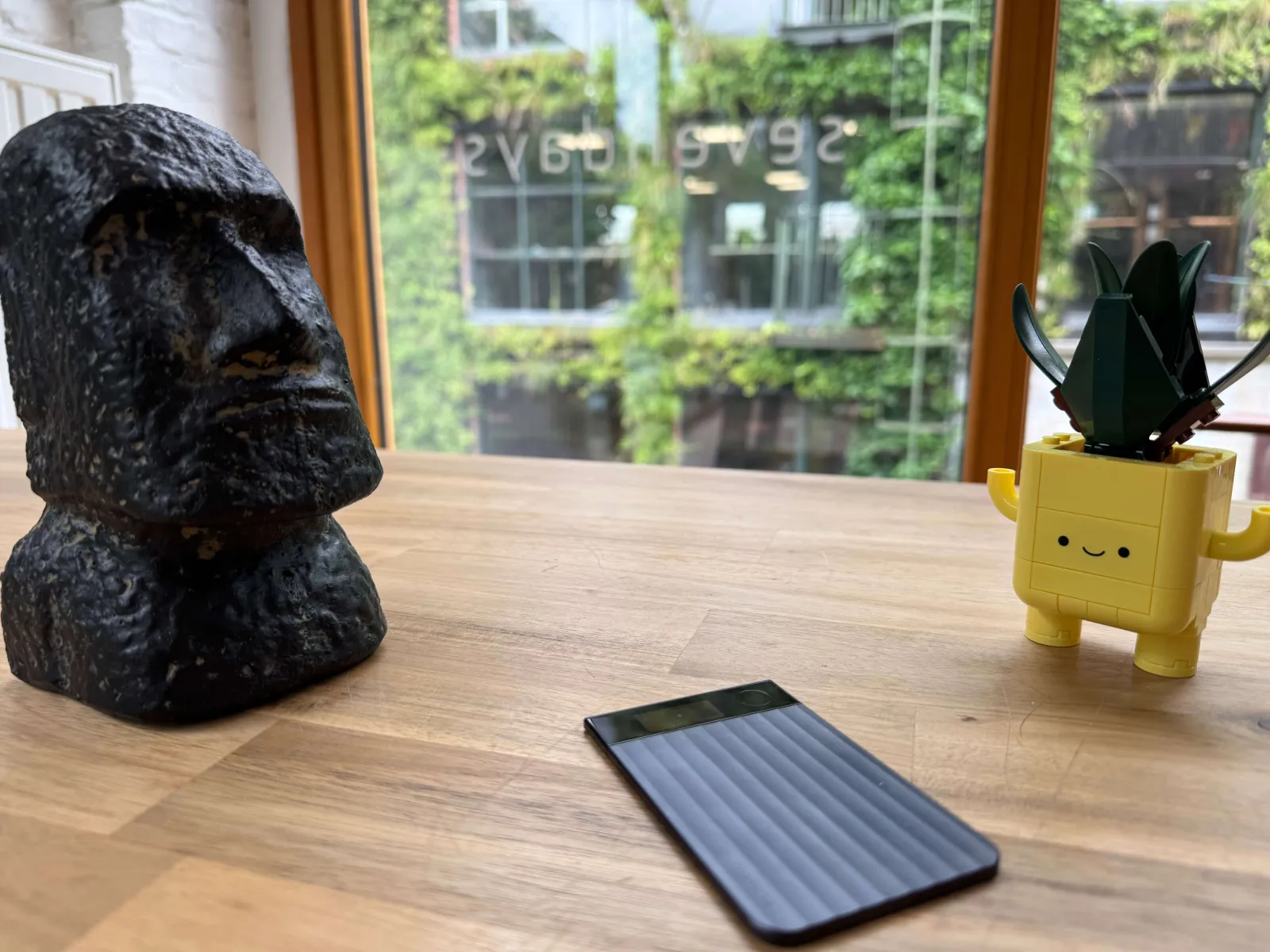
Plaud is a small recorder that fits in your pocket or sticks to your phone. It records your conversations, automatically turns them into text, and produces a clear summary with the decisions and action items pulled out. No buttons, no fuss: record, and the rest happens by itself.
Plaud is the device we recommend most often, but the approach isn't tied to one brand. The same principle works just as well with recordings that come from somewhere else, like your phone system or another tool. The device is just the start, the real work is in what you do with those recordings afterwards.
The device comes with an app for your computer on top of it. That app records your video calls, on any platform: Microsoft Teams, Google Meet, Zoom or anything else. So there's nothing to pick or set up per tool. And the nice thing is that those online conversations follow exactly the same path as the physical recordings: record, transcript, summary, and then into your company brain.
So it works for every kind of conversation:
- Client conversations, at the table or on site.
- Internal meetings, from a quick stand-up to a long strategy session.
- Online video calls, in Teams, Meet, Zoom or any platform, via the app on your computer.
- Phone calls from your smartphone, which otherwise get recorded nowhere at all.
The result is always the same: a transcript and a summary that are simply there, without anyone having to spend time on them.
By now there are plenty of tools to record video calls: Fathom, Fireflies, Tactiq, Granola, Notion, Otter, Leexi, or the built-in recording in Microsoft Teams, Zoom and Gemini in Google Meet. All useful, but each stays limited to online meetings, and often to a single platform. None of them covers your in-person conversations at the table, your video calls and your phone calls from your smartphone, whatever tool you use. That full, worry-free coverage is exactly what Plaud does give you: every conversation captured, online, in person or from your smartphone, without wondering whether the right tool is running. And if you want to fully capture your telephony too, both your smartphone and your landline, Telsmart is certainly a good solution to plug into.
Why recording every conversation makes sense
A process that runs automatically is reliable. It doesn't depend on who's in a good mood or who happens to have time. And that changes more than you'd think:
- You're fully present again. No more half an eye on your notepad. You listen, you think along, you ask better questions. The recording handles the rest.
- Nothing gets lost. Every agreement, every figure, every nuance is there in black and white. A dispute about what exactly was said? You simply read it back.
- The knowledge belongs to the team, not to one person. A colleague who wasn't in the conversation reads the summary in two minutes. Onboarding a new employee goes a lot faster.
- You build a memory. Months later you can still find what you agreed with a client, without digging through emails or someone's head.
Spoken communication is, in most companies today, the biggest blind spot. Everything that gets written, emails, documents, messages, is stored somewhere. But the most important things often happen in a conversation, and that evaporates. Capturing it automatically secures exactly the layer you used to lose.
The Sevendays layer on top of the recording
A recorder like Plaud already gives you a summary per conversation. But a summary that stands alone doesn't know who your client is, which quotes are open, or what you agreed last month. That's where we add a layer. And that layer is independent of the device: whether your recording comes from Plaud, a meeting tool or your phone system, what happens next is the same.
We connect those recordings to your company's knowledge and context. So the system knows who your clients and contacts are, knows your projects and your way of working, and attaches every conversation to the right file straight away. A client conversation doesn't land in a loose folder, but under the right client, next to the quote, the emails and the tasks that are already there.
That way it fits neatly into the "meetings" channel of your platform: together with your email, your telephony and your messages, every conversation comes together into one timeline per client and per project. How we tie those channels and systems together, you can read on our Connect page.
And it goes further than just storing. Plaud recently launched its own connection (MCP) that makes your transcripts directly available to AI tools like Claude. We hook that connection up to your own company brain. As a result, you can simply ask questions about your conversations: "What did I agree with Client X last week?" or "Draft a follow-up email based on this morning's conversation." And the answer doesn't start from general web knowledge, but from your own clients, projects and vision.
That's exactly the second layer we wrote about earlier in Claude for yourself, or for your whole company: not one person's gain, but something that lives in your processes and moves the whole team forward.
The same enrichment as your other channels
Once the recordings are in your company brain, they get the same clean-up and enrichment we already apply to your other channels. Plaud gives you a transcript and a summary on its own, but we lift those to the level the rest of your company brain reaches too. A raw recording becomes a clean, reliable source:
- The best transcription for Flemish. We pick the transcription service that handles our dialect and accent best, instead of whatever comes as standard.
- Noise and filler words removed. "Um", half-sentences and repetitions are cleaned up, so you're left with a report that actually reads well.
- Names and jargon spelled correctly. Client names, product names and technical terms that come out of the transcription wrong get corrected against your own glossary.
- Tasks in your own system. The action items from a conversation land automatically in the task system you already use. Far stronger than at the bottom of a report, where they get lost and never really secured or followed up.
The result: a recording is no longer a loose audio file, but an enriched source that is correct straight away and usable for your whole team.
A concrete example
- Agreed on the €25,000 quote
- Delivery set for end of July
- Client wants an extra reporting module
Every conversation captured automatically, summarised and searchable for your whole team.
A salesperson has a conversation at a client's office. He puts Plaud on the table and simply has a good conversation, without taking notes. On the way back to the office the summary is already there: quote agreed, delivery by the end of July, a request for an extra module.
With us, that summary lands automatically under the right client in the CRM, with the action items ready. The planning colleague sees the delivery date, the manager sees the state of play without having to ask. And three months later, when a new question comes in, the system still knows the whole history. Nobody had to type up a single report for it.
And what about privacy?
Recording conversations calls for care, and we take that seriously. Always be transparent: let people know you're recording and why. A conversation you take part in yourself, you may capture for internal use, but the other side needs to know where they stand. That's not just good manners, it's the basis of trust.
When it comes to data, we hold the same line as with all our solutions: your recordings and transcripts stay within Europe and are never used to train external AI models. What that means exactly, you can read in EU hosting and zero retention. That keeps you covered, both for GDPR and the EU AI Act.
How we help you with this
We help you turn loose recordings into a real company memory. We make sure Plaud connects to your systems, that every conversation lands with the right client and the right project, and that your team can query it as if it were a colleague who sat in on every conversation. Not a tool that stands on its own, but a layer that runs along with your daily work.
Curious what that looks like for your company? Book an introduction or see which use case comes closest to your situation. We listen first, then we build alongside you.