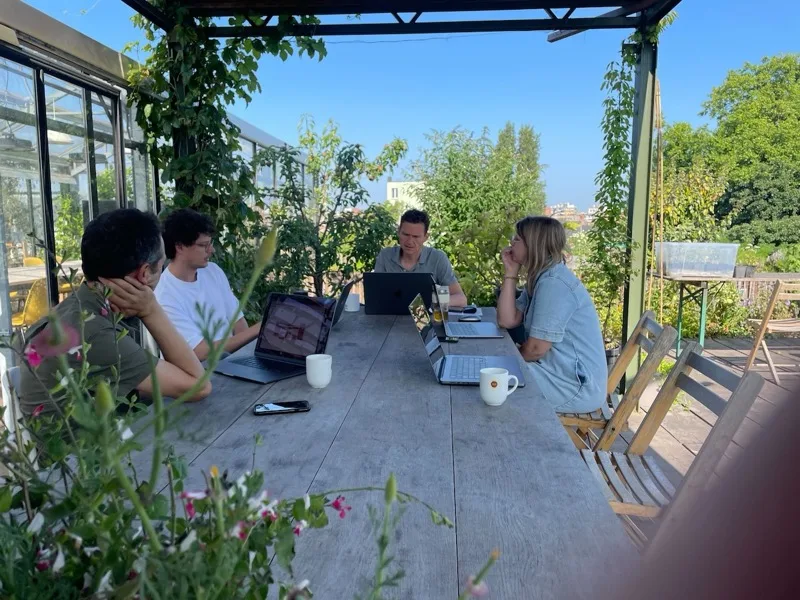
Over the past two weeks I had strategy conversations with four Flemish SMEs. None of them had anything to do with the others. Different sector, different scale, different clients, different culture. And yet the exact same sentence came up in every single meeting:
"We want to grow. But we don't want to hire someone right away."
Not once, as an afterthought. Four times, explicitly, often as the opening line of the conversation. That's not a coincidence. That's a pattern.

Four sectors, one pattern
An insurance broker in Antwerp, two owners, too busy to keep up. A construction firm with six people on site and a hundred and fifty open tasks in the system. A training centre for the transport sector that keeps growing while the admin grinds to a halt. A wholesaler where one employee loses hours a day to paperwork.
Four completely different stories. But line them up and they all say the same thing:
- Business is good. Too good to keep up with.
- The team isn't the problem, the team is solid.
- The next hire feels inevitable, but also expensive and heavy.
- And above all: the growth won't come from more people, it'll come from working smarter with the people they already have.
Nobody says "we don't want to hire anyone". They say "we want to see if there's another way first". That's a fundamentally different starting point than five years ago.
Why now?
Three forces are converging in 2026. None of them is new, but together they form a tipping point.
The labour market is tight. Finding a good administrative hire takes months. A good technical profile takes longer. And once they're on board, a full-time employee costs between €45,000 and €60,000 a year, all in. For an SME with two to ten people, that's no small decision.
AI is mature enough. Two years ago, AI was an experiment. Today, every one of these four businesses already has bits of AI running, sometimes without realising it. The difference is that the tools are now reliable enough to do real work, not just demos.
The question has changed. Five years ago the question was "can AI do this?". Today it's "should I even have a person doing this?". That's a much sharper question, and it's coming up more and more often.
Three bottlenecks that keep coming up
The same three pain points surfaced in every one of the four meetings. Not by chance. They're exactly the spots where time leaks away every week without anyone owning it, and where the pressure to take someone on grows the strongest.
1. Email handling and follow-up
In three of the four businesses, staff type out the same answers to the same questions every week. Customers keep asking the same things: the status of a file, a delivery date, invoice details, outstanding items. No templates, no central memory. The answer gets dug up from two or three systems and typed out again, every time. Two minutes per email, thirty to fifty times a day.
At the training centre, email comes in across four different inboxes: info, planning, accounting and admin. Customers send to the wrong address. Replies get lost. Staff don't know what colleagues have already promised. A new hire would lose days just learning the system.
This isn't work a human should be doing. This is work a human should be reviewing, while AI prepares it, sorts it and drafts it ready to go.
2. Document processing
At the wholesaler, large PDF files come in every day, each bundling ten to twenty different documents. The employee only needs a few of them, but has to open every one, check it, split it, rename it and file it in the right folder.
At the construction firm, bills of quantities arrive from subcontractors. Large spreadsheets that have to be split by type of work, matched against internal price lists and sent on to the right subcontractor. A single one can take two to three hours.
AI does this in minutes. With the same precision. Without complaining on a Friday afternoon.
3. Central customer knowledge
This was the pattern that came up in all four meetings. Customer information is scattered across email, phone, WhatsApp, the CRM, OneDrive or Google Drive, and people's heads. Nobody has the full picture. A new colleague has to piece it all together from scratch.
The question every owner asked, almost word for word:
"Can I just ask what we agreed with client X?"
Yes, you can. That's exactly the layer we build for businesses. No new system, no replacing what's already there. A layer on top that reads every source and makes it answerable.
The question to ask first
In three of the four meetings, the conversation started with the solution: "Can you build us an AI assistant?". In one meeting, it started with the problem: "Come and look at where our time leaks away". Guess which approach works.
This is the advice we give more and more often:
Whoever picks the tool first usually ends up with a handful of disconnected licences that don't talk to their other systems, and that a better option from another vendor will likely replace within a few months. Whoever describes where the time leaks away first builds something, with the very same budget, that saves five to ten hours a week.
Start small, not everything at once
The second piece of advice we repeated in all four meetings: don't try to do everything at once. The ambition to "automate everything" is a great way to be frustrated within three months with nothing in production.
What does work:
- Pick one process that hurts every week. Just one. With a visible effect.
- Not necessarily the most complex one. A quick win builds buy-in faster than a big, ambitious project, and immediately frees up time so your team can take on the more complex work themselves.
- Build a working solution for it in four to six weeks.
- Let it run for a quarter. Measure what it delivers.
- Only then do you add the next one.
Boring, but it works. A working solution that saves five hours a week builds internal trust for the next step. A big, ambitious project that sits in development for six months builds internal distrust.
There's another reason to start small: AI is evolving so fast right now that a long project is almost guaranteed to be outdated by the time it goes live. What looked like the smartest solution a few months ago has sometimes already been overtaken by a new tool, a better model or a cheaper vendor. Short projects let you move with that evolution. Long projects chase after it.
The maths is simple
One administrative employee costs an SME roughly €45,000 to €60,000 a year, all in. A well-scoped AI project for a specific process typically runs between €5,000 and €15,000 to set up, with operating costs of a few tens to a few hundred euros a month.
So the comparison isn't "AI replaces a person". The comparison is "AI does the part of the work nobody enjoys anyway, and the team you already have can focus on the genuinely valuable part". That's a better deal for the team, for the customer and for the business.
Asking the question before you hire
By the end of 2026, the difference between Flemish SMEs won't be who hired the most people, but who asked the right question earliest. Not "who do we look for?", but "do we need to look at all?".
Or, as one of the four owners put it this week: "We have the people we have. How do we free them up for the work they're genuinely good at?" The personal client contact, the advice, the creative thinking, the relationships that make a business grow. That's exactly where people add value, and exactly the work that drowns, far too often, in repetitive admin.
That's the question of 2026. And the answer rarely lies in a job posting.