Once your website is live, the daily work begins: managing, updating, translating, and keeping the content findable and consistent. Usually that happens through a CMS, the system where you enter and edit your pages. Just like the other administrative processes we've written about, AI has become a huge help there.
An AI that thinks along, not just executes
This is perhaps the biggest difference with a CMS. A CMS is passive: you type in your text and it dutifully stores what's there, but it says nothing about the quality. With AI you effectively get a virtual colleague, a partner that writes with you and thinks along about your content, and gives advice back. "This is too much text", "this is too vague", "this could be more convincing", "that heading sounds stiff, this is more natural", "this repeats what you said above".
That goes further than a spell check. You have someone watching structure, tone, findability and the coherence with the rest of your site, and who not only helps write but also thinks along about managing and keeping it up to date. Just the kind of colleague a small team doesn't always have. So you work not only faster, but also better, because someone is continuously looking along to keep you sharp.
Your website hangs off your company brain
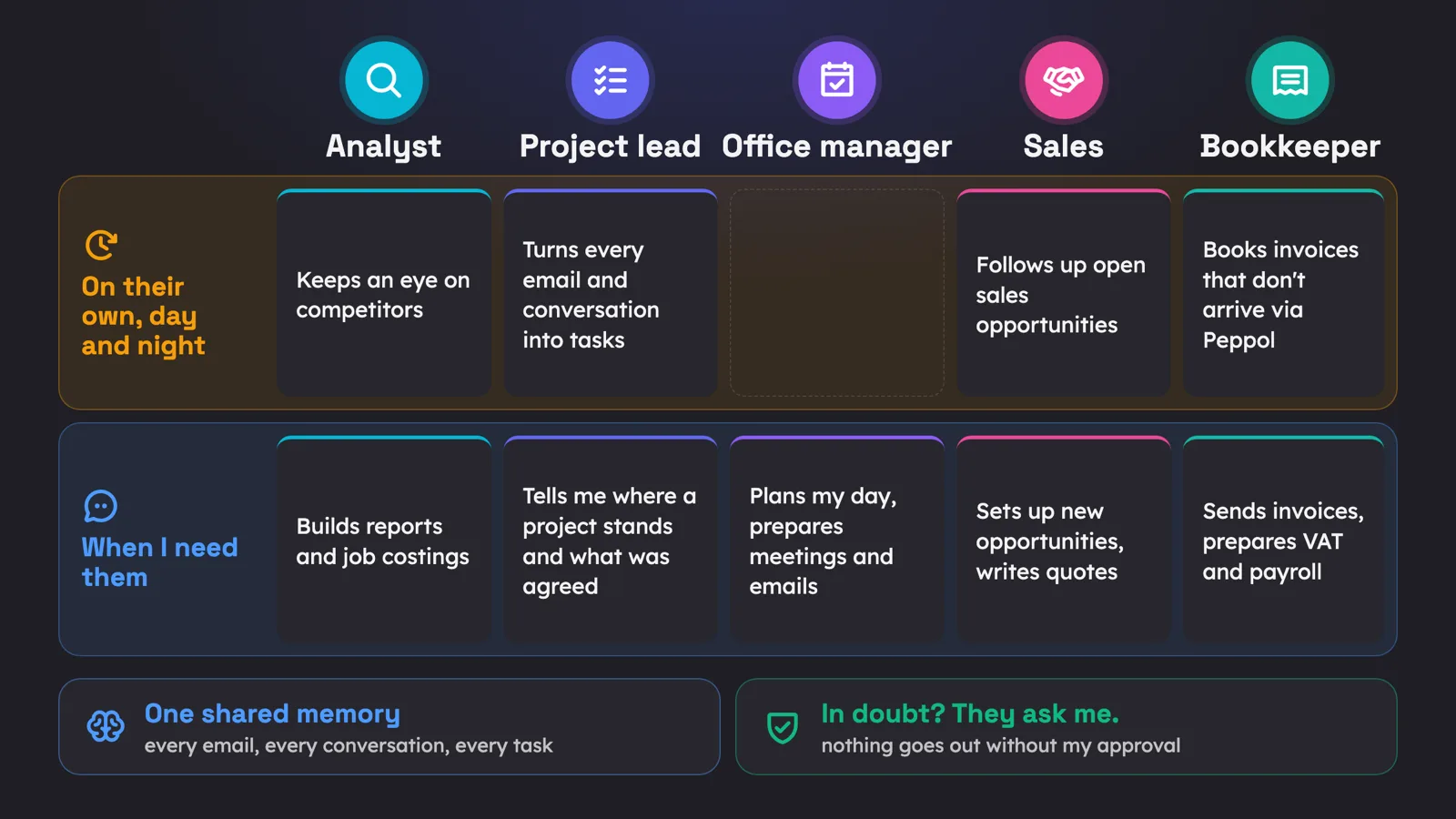
The site no longer stands on its own. It draws from the same source as the rest of your business: your own documents, your knowledge base, and what comes up in sales conversations and customer questions. That way your website is no longer an island, but an expression of your company brain. That gives you two things:
- Ideas that come from somewhere. The next article or FAQ doesn't have to come from a brainstorm. What keeps coming up with customers is your topic straight away. More on that in content at scale.
- Consistency across your whole business. The same facts, terms and tone on your site, in your knowledge base, in your quotes and in your customer service, because everything starts from the same brain.
- Ready whenever you want. Because the content starts from what's already there, an article or page can be fully prepared and parked until you decide to publish. So you can work ahead, at your own pace.
It doesn't depend on who does it
If a colleague adds an article, the same checks, style and guidelines are followed. Those guidelines are anchored in the central layer of your platform, not in one person's head. In a CMS the result depends more on who enters it and whether they know all the rules; here it stays consistent, no matter who gets to work.
Translation happens along the way, not afterwards
Every page comes in two languages at once and stays in sync. No separate translation round, no NL and EN versions that slowly drift apart. You think about the content once, instead of twice about the same page. And you don't need a separate translation service, tool or extra subscription for it; it's simply part of creating your content.
Automatic checks and corrections
This is exactly the kind of work that easily gets left behind in a CMS, not because it can't be done there, but because you have to remember it manually with every change. With an AI approach you can bake it in by default, so it stays correct with every change:
- SEO: canonical, hreflang, sitemap and redirects are always right. Move a page and the link moves with it, without broken links or lost findability.
- GEO (findability in AI answers): structured data and a readable site catalog, so not only Google but also AI search engines pick you up correctly.
- Security: the right protection is on by default, not an afterthought.
Pages link to each other on their own
Internal links and "read next" blocks are laid out and updated automatically. Add a page and the references elsewhere follow along, instead of you having to hunt them down one by one. You even get suggestions for related pages, so you place links and references where they genuinely make sense. That way your site stays coherent without manual work.
From a static form to a chat that answers
You can also offer your own content directly to your visitors. Instead of a classic, static contact form or a mediocre search function, the visitor gets a chat that answers based on your own pages and documents. Questions are answered right away with your real information, instead of tucked away behind a form someone has to respond to later. Read more about that shift in our article on moving from a classic website to an AI agent.
That way your content gets double value at once. Everything you make doesn't just sit on a page, but also becomes available dynamically in the chat, exactly when a visitor asks for it. And it works both ways: the chat also shows you where visitors are looking but finding no answer, so you immediately know what content your site is still missing.
Name
Your question
SendThe question lands in a mailbox. A reply comes later, if someone has time.
The visitor gets an answer right away, from your own content.
AI helps, but doesn't take over the knowledge
AI dramatically lowers the threshold to build a site, but it doesn't take over the knowledge. You still need to know what a good website has to meet: that it's secure, loads fast, is technically sound, is findable and keeps working when something changes. Those are the parameters you steer on, and that's exactly where someone with the right background has to pay attention.
Anyone who lets AI "vibe code" a few pages without that knowledge and blindly trusts it rarely gets a great result. On the contrary, you run real risks: bugs, security holes, a site that suddenly goes offline, or reputational damage. The AI does the work, but someone has to know what needs to happen, make the right choices and judge the result. And that applies not just to a website, but to just about any AI-generated solution or piece of content. That's where the value lies, not in the tool itself. Building and technical setup are therefore expert work, best done with a partner who knows what they're doing. AI is best deployed where it truly flows: the daily management of your content.
Where a CMS is still better
To be honest: if you build purely with AI, you miss a few things that a good CMS gives you as standard:
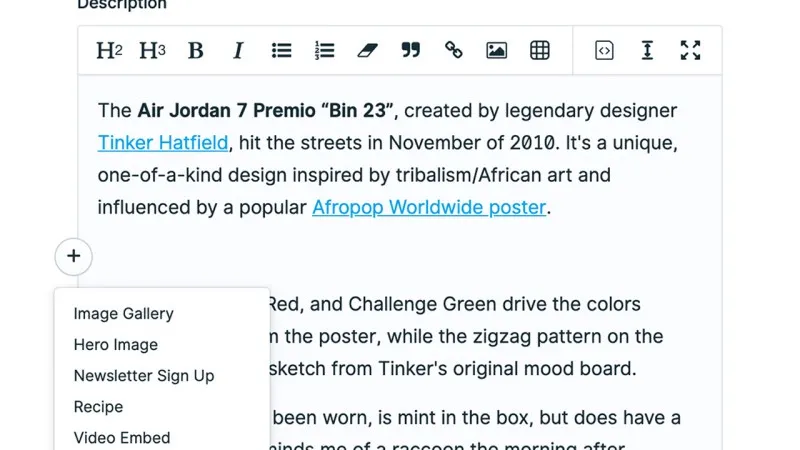
- A pleasant editing environment with a preview, so you see right away what a change looks like.
- Reusable building blocks for consistent page structure, and your AI assistant can use those same building blocks to build new pages in the same style.
- Version history to restore an older version in one click.
- Roles and permissions, so each colleague only touches their own parts.
- A media library, forms and a menu you drag and adjust yourself.
Just the kind of things that keep a site workable for those who don't want to deal with the tech. That's exactly the part where you want a human at the wheel.
The future is hybrid
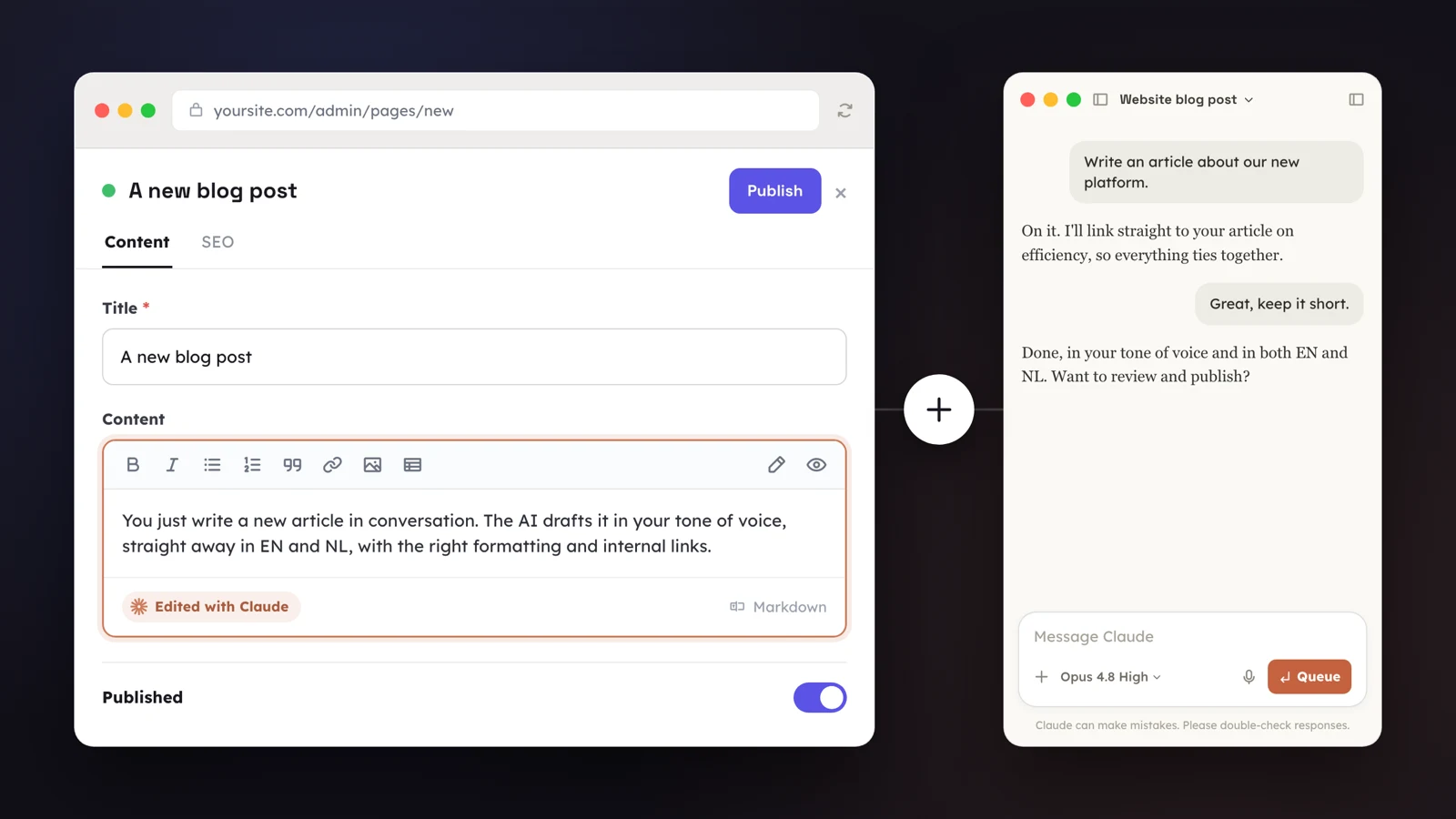
So it's not one or the other. The strongest approach combines both: AI for what makes it strong (generating, translating, keeping the checks and links automatically correct, many pages at once, and updating) and a CMS for the human side (manual adjustments, one-off pages, colleagues who edit something themselves without code). Fully generated and updated pages via AI, with real CMS features alongside to fine-tune.
It's the same thread as always: AI does the repetitive work, the human keeps control where it matters. Your website then becomes not a loose bit of published text, but knowledge that plays a part everywhere in your business.
Thinking about a new site, or a smoother way to maintain your current one? We're happy to show you what that hybrid approach looks like in practice. Book an introduction or take a look at our examples.