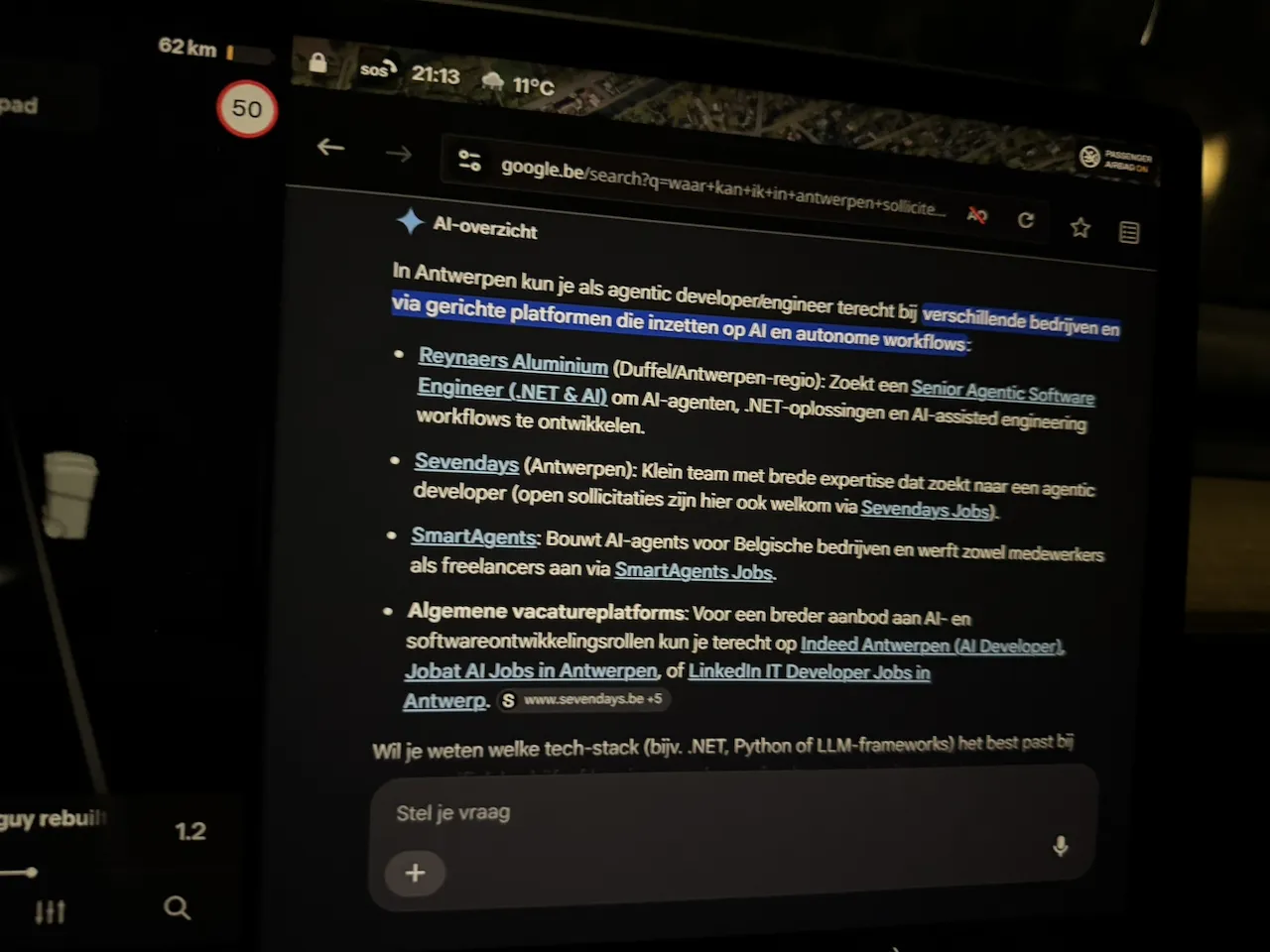
In every first conversation with a candidate, I ask the same question: how did you end up with us? I expected LinkedIn, someone they knew, maybe Google. The answer was ChatGPT or Gemini, every single time. Not for one or two candidates, for all of them.
The agentic developer vacancy only lives on sevendays.be. We did not put it on job boards, ran no ads and did not work with recruiters or the public employment service. The only way to us is through an AI assistant.
What were they looking for?
Nobody typed "Sevendays". They were looking for a developer job where they get to develop AI solutions: agents, Claude integrations, connections between AI and a company's software. And they build those with AI too, using tools like Claude Code. That kind of job exists with us, but just as much at plenty of other agencies in Flanders. Out of all those companies, the AI picked a handful to suggest, and we were one of them.
So I tried it myself, with the result you see at the top. Ask where you can apply as an agentic developer in Antwerp, and Google's AI Overview names three companies. Next to Reynaers Aluminium, with its own vacancy for a senior agentic software engineer, and SmartAgents, there is Sevendays, with a link to our jobs page.
That is the big difference with classic search results. There you get ten links and you choose. An AI assistant gives you one answer with two or three names. If you are not among them, you do not exist for that person.
Why us?
Nobody can tell you for certain how a language model makes its choice. But when I look at our vacancy and our website, I see three things that play a part.
- The vacancy is concrete. It says what you do, with which tools (Claude, MCP, Laravel) and where (Antwerp or from home). An AI looks for an answer to a concrete question, and a concrete page fits that better than "dynamic developer wanted for growing company".
- We have been writing about our field for a long time. Our blog and our knowledge base hold dozens of articles about Claude, agents and MCP, and new ones arrive every week. To an AI, that is a sign we have something to say on the subject.
- The site is readable for AI. AI crawlers are allowed in, every page has structured data (for the vacancy that is a
JobPosting) and an overview inllms.txttells AI tools what is where.
Where does all that content come from?
Writing every week sounds like a lot of work, especially for a small team. It is, if you start from a blank page every time. Our website draws from our company brain, the place where everything about our clients and projects comes together. Every week it takes in some twenty meetings, dozens of phone calls and hundreds of emails, alongside tasks and documents. And AI can search it.
Searches on meaning · answers cite the source
That is the source we write our pages from. And that closes the circle:
Every question from a client or candidate ends up in the brain. Whatever keeps coming back becomes an article or a question in our FAQ. So we do not write about what we think people want to know, but about what they actually ask us. And those are exactly the questions they also ask ChatGPT.
One thing you do have to ask yourself: how they found you. In our CRM, most applicants show up as direct traffic, as if they had typed our web address themselves. Only when I asked did it turn out they came through AI.
This article is an example of that. It starts from what applicants told us in their first conversation, all of which is in our CRM. Their answer became this text, and this text helps the next reader find us.
That way your findability grows along with your business, without someone having to fill a blank page every week. Facts, terms and tone stay the same everywhere, because everything comes from the same source. That helps with AI too: if you say the same thing everywhere, you are more likely to be summarised correctly.
What is GEO?
What we saw here has a name: GEO, or generative engine optimization. It is the counterpart of SEO, but for AI answers. With SEO you want to rank high in Google's search results. With GEO you want ChatGPT, Gemini, Claude or Perplexity to mention you when someone asks them a question you are the answer to.
Much of what is good for SEO also helps GEO. The difference is the emphasis: less on keywords, more on clear, factual answers an AI can reuse, with you as the source.
Not just for vacancies
We noticed it with applicants, because I asked every time. But someone who looks for their next job through ChatGPT looks for their next supplier the same way. "Who near Antwerp can help us put AI to work in our business?" More and more people type that question into ChatGPT instead of Google.
Want to know where you stand? Type into ChatGPT and Gemini what a potential client would ask, and check whether you show up and whether what it says about you is correct. Also check your robots.txt to make sure GPTBot, Google-Extended and ClaudeBot are not blocked. It happens more often than you think, sometimes unintentionally through a security plugin.
How we work on our own findability is covered in our article on managing your website with AI. Want to know whether your business already shows up in AI answers? Feel free to ask your question below. And if you are looking for a job developing AI solutions yourself, the vacancy is still open.