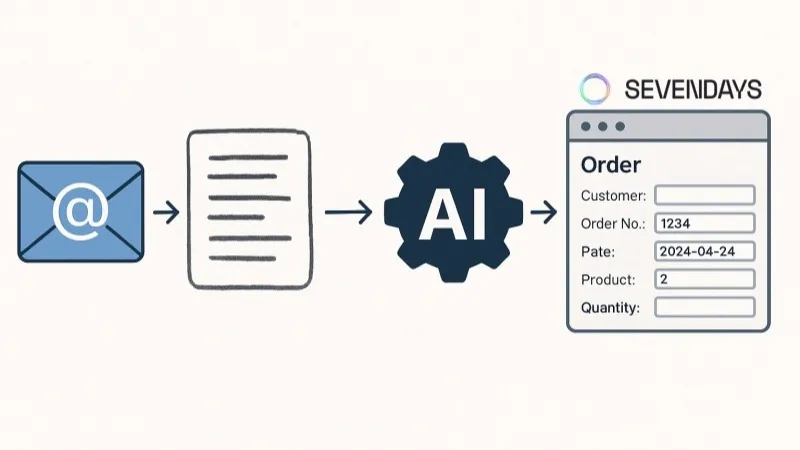
Many websites have great content: strong copy, visuals and products. But search engines only see what's on a page, not what it means. Is it an article? A service? A product? An event?
That semantic gap is exactly what JSON-LD solves. And as generative AI systems like ChatGPT, Perplexity and Gemini no longer crawl the web to show links but to write answers, structured data has also become the key to GEO, Generative Engine Optimization. At Sevendays, we take it one step further: with AI-generated JSON-LD, automated and scalable.
What is JSON-LD?
JSON-LD stands for JavaScript Object Notation for Linked Data. It is a way to tell search engines exactly what your page represents, in a format they understand. For this blog post, Google knows: this is a blog article, with a title, author and description, which increases the chance of a rich appearance in search results.
-800.jpg)
Why JSON-LD matters
- Better visibility in search engines With structured data, search engines understand your page better. This leads to rich results, think stars, prices, FAQs or breadcrumbs, that make your result visually stand out.
- More clicks (higher CTR) Rich snippets not only increase visibility, but also generate 20–30% higher click-through rates.
- Ready for AI search, voice search and GEO New search experiences like Google Gemini and ChatGPT Search are increasingly using structured data to generate reliable answers. JSON-LD makes your content AI-ready, and increases the chance that you are not only found, but also cited in a generated answer. As a complement, we also make pages available as markdown, so AI crawlers can process the pure content even more easily. JSON-LD delivers the context, markdown delivers the readability.
- Technically clean and easy to maintain Unlike Microdata, JSON-LD requires no extra HTML tags. Everything sits neatly in a <script> block, separate from your layout, simpler, faster and less error-prone.
Better visibility in search engines With structured data, search engines understand your page better. This leads to rich results, think stars, prices, FAQs or breadcrumbs, that make your result visually stand out.
More clicks (higher CTR) Rich snippets not only increase visibility, but also generate 20–30% higher click-through rates.
Ready for AI search, voice search and GEO New search experiences like Google Gemini and ChatGPT Search are increasingly using structured data to generate reliable answers. JSON-LD makes your content AI-ready, and increases the chance that you are not only found, but also cited in a generated answer. As a complement, we also make pages available as markdown, so AI crawlers can process the pure content even more easily. JSON-LD delivers the context, markdown delivers the readability.
Technically clean and easy to maintain Unlike Microdata, JSON-LD requires no extra HTML tags. Everything sits neatly in a <script> block, separate from your layout, simpler, faster and less error-prone.
How we approach it
At Sevendays, we implement JSON-LD not manually, but automatically via AI. Our AI "reads" the context of the page, product, article or service, and translates it into correct JSON-LD markup.
What does this AI do?
- Automatic analysis of the page
- AI-generated metadata: titles, authors, prices, availability, etc.
- Scalable implementation: works for hundreds of pages simultaneously
- Reduced risk of human error
Automatic analysis of the page
AI-generated metadata: titles, authors, prices, availability, etc.
Scalable implementation: works for hundreds of pages simultaneously
Reduced risk of human error
This saves time, improves consistency and ensures that every page contains a JSON-LD description.

Future-proof with JSON-LD
The role of structured data is growing explosively. As AI search engines like ChatGPT, Gemini and Perplexity extract information from websites, metadata plays a key role in context, reliability and ranking.
By implementing JSON-LD, you build a foundation that:
- helps search engines understand what you offer,
- helps AI systems cite your content correctly in generated answers,
- and helps users find what they are looking for faster.
helps search engines understand what you offer,
helps AI systems cite your content correctly in generated answers,
and helps users find what they are looking for faster.
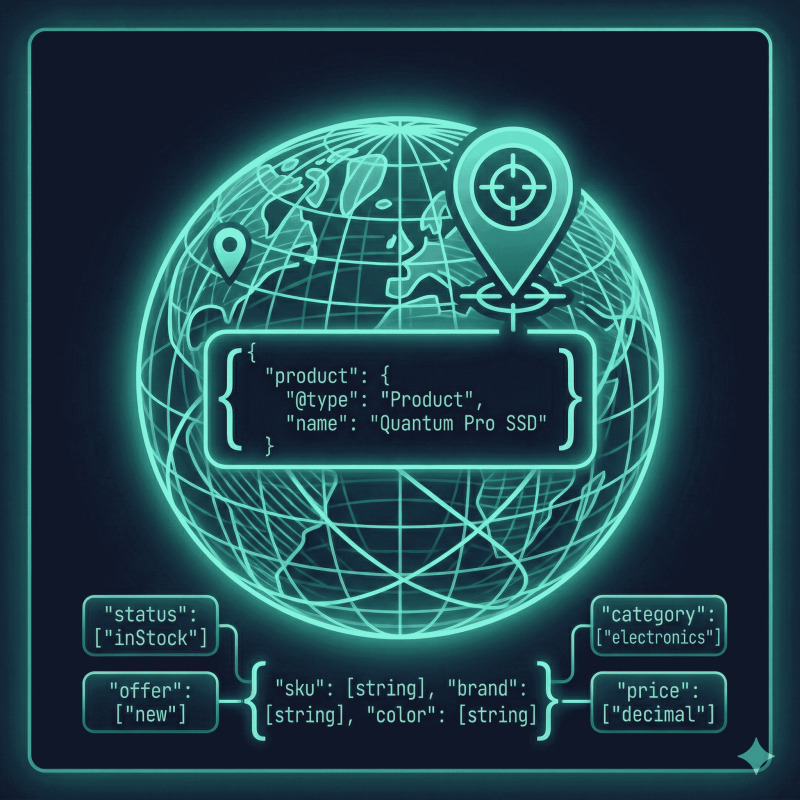
What JSON-LD does not solve
JSON-LD describes your page, but does not replace the content itself. An AI system visiting your website still has to navigate through navigation menus, scripts, cookie banners and styling to reach the actual text, and that regularly leads to noise, missed information or incorrect citations.
That is why you can complement JSON-LD with a number of additional measures:
- Markdown pages for LLMs. For each page, we make a clean markdown version available via a separate endpoint. No formatting, no distractions, just the content, in the format on which large language models perform best.
- llms.txt. A simple text file in the root of the website that tells AI crawlers which pages are available and how the site structure is organised. Similar to what robots.txt did for classic search engines, but aimed at LLMs.
- Strong, clear writing style. Generative AI cites content that is clear, direct and well-structured. Vague or generic texts are less likely to be picked up as a reliable source.
Markdown pages for LLMs. For each page, we make a clean markdown version available via a separate endpoint. No formatting, no distractions, just the content, in the format on which large language models perform best.
llms.txt. A simple text file in the root of the website that tells AI crawlers which pages are available and how the site structure is organised. Similar to what robots.txt did for classic search engines, but aimed at LLMs.
Strong, clear writing style. Generative AI cites content that is clear, direct and well-structured. Vague or generic texts are less likely to be picked up as a reliable source.
JSON-LD is therefore an essential first step, but GEO requires a broader approach in which metadata, content and technical accessibility move forward together.
Our vision at Sevendays
Being found online no longer means just keywords and backlinks. It is about semantic visibility, how well a search engine and an AI system understand what you offer. With an AI-driven JSON-LD approach, we ensure that every website is contextually clear, technically sound and future-ready. Whether it is a webshop, blog or corporate site: structured data is the bridge between humans and machines.

Discover our other posts

AI-powered proposals that close more deals
12 March 2026
7 min
-small.webp)
Smarter SEO and GEO with JSON-LD
09 March 2026
4 min
Every Message, Every Channel: Why We're Speaking at AI5050
05 March 2026
6 min

From production floor to connected AI solutions: why human + machine truly works
03 February 2026
5 min