We train your team
- Working with Claude and ChatGPT
- On your own tasks
- Useful right away, no theory
We fine-tune and keep training
- Follow-up on what works
- Go deeper where needed
- AI baked into the routine
We build along where needed
- Where off-the-shelf AI stalls
- Integrations and automations
- Custom apps
Almost every company now has an AI subscription, often several. And yet little changes on the work floor. That's rarely down to the tool. AI success lies only for a small part in which tool or model you pick, and much more in your people: the knowledge they build and a new way of working with AI. That's exactly where the gains are, and exactly what we're now focusing on: Sevendays trains your team in AI.
Seen a webinar, now what?
Everyone has sat through an AI session at some point. Interesting to watch, but a week later little has stuck. The reason is almost always the same: it was about generic examples, not your emails, your quotes, your files, your clients. Knowledge you don't apply to your own work right away simply fades.
So we flip it around. We don't start from a presentation about "everything AI can do", but from what's actually on your desks. That way the time goes straight to what matters, and everyone leaves with something they can use the next day.
You don't need what everyone comes to sell you
There are plenty of trainings and salespeople going around telling you what you "absolutely need". Often it's a fine tool or an impressive demo, but whether it actually delivers in your business is a whole other question. What's worth gold at one company sits unused in the cupboard at another.
So we don't start from what we'd like to sell, but from where you're losing time. Sometimes the answer is a solid project, often it's simply teaching your team to work better with the tools you already have. You don't pay for an impressive idea, but for what actually makes the difference in your situation.
Nobody knows your business better than your own team
Let's be honest: we know AI, but you know your clients, your processes and your pitfalls. The best use cases don't come from our heads, but from the people who do the work every day. They know where time is lost and where a mistake hurts. No external analysis will surface that knowledge on its own.
The thing is: your team does know where it pinches, but often not what AI can already do about it today. That's exactly the shift many can't make on their own, simply because they don't know what's possible. So we don't just listen to your processes, we inspire right away. For every pain point we show what technology and AI can concretely mean for it today. The best ideas emerge in the conversation itself, where your knowledge of the business and our knowledge of what's possible come together.
That's precisely why we train, rather than just building something for you and disappearing. Many agencies make you dependent: they build, you call back for every change. We do the opposite. We make your team stronger, so it picks up the small things itself, and we only build along where it gets genuinely complex. Your business knowledge plus our building power, that's the combination that sticks.
How we run a training
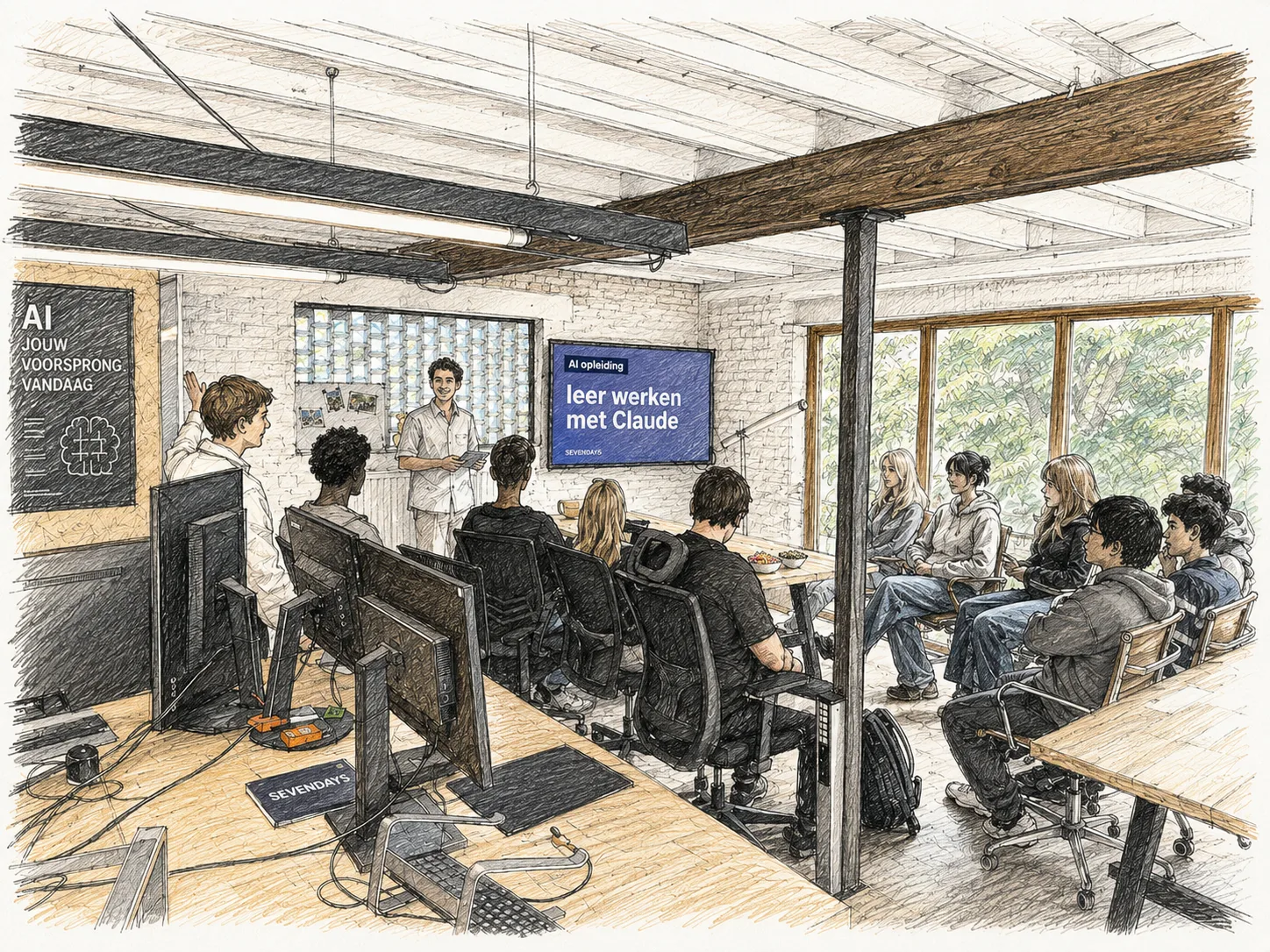
No generic slides, but a session built around your situation:
- Intake beforehand. We ask which tools you already use, which tasks eat the most time and where the real frustration sits. So the session doesn't start from zero.
- Small and concrete. We work on your real tasks, not on toy examples.
- Two or three use cases from your own business. Not trying everything at once, but a few things that pay off right away.
- Everyone builds something small themselves. Organising your inbox with Claude, for instance, and you take that back to your own desk.
- Shared agreements. So AI works the same way for everyone, instead of each colleague doing their own thing.
From AI next to your work to AI inside your work
This is where the real jump is. A training gets your team to AI next to the work: writing faster, looking things up more smoothly, prompting better. Valuable, but it stays manual work. The real gain comes when steps simply disappear: systems talking to each other, work that happens on its own, tasks you no longer have to do rather than merely doing them faster.
That's the next rung, and it's exactly where we're strong. When you hit the limits of loose chats, we build AI inside your work: integrations, automations and custom apps, woven into your processes and systems. Your trainer also knows what can be built, because they build it. Read more about that in our piece on growing without hiring.
What a training looks like
On what you actually do, in a small group. From a single session with follow-up to a longer track, depending on your team and your goal.
Tailored, from one session to a track
An experienced Sevendays expert gets to work with your team on your own tasks. We match the number of sessions and the follow-up to what you need.
- At your office, on your own tasks
- Intake beforehand, follow-up between sessions
- Small group, so real interaction
- Scales with you: one session or a longer track
Start with whoever gives the room
Often an owner or management team wants to know where they stand for themselves first, before the whole team joins in: what can AI really do today, what can't it, and what risks come with it? Only once they have that clear themselves do they set the rest of the team to work with knowledge and confidence. After all, it's hard to steer something you don't yet fully grasp yourself.
That immediately removes the biggest brake. Because the barrier to AI is rarely a lack of knowledge, but the lack of permission: people only dare to experiment once it's clearly allowed from the top, even if not everything works right away. So we often start at the top, first the management that gives the room and the budget, and from there step by step the team. That way AI doesn't become the loose initiative of one enthusiastic colleague, but something the whole company carries.
Learning isn't a goal in itself
Learning AI isn't an end point. It's about what you do with it on your own work: less time lost on the repetitive, more room for where you really make the difference. A training gets your team going, and where it gets more complex, we're ready to build along.
Want to let your team get a taste of what AI can mean for you? Book an introduction, or first take a look at our examples.