A manufacturing company recently asked us this. Their own ERP runs on Azure, sales lives in a CRM, parts in a second package, and everyone works in Microsoft 365. They want AI that works with the data from all those systems: reading it, connecting the dots and later also changing records itself. And preferably in Europe. Does everything have to leave Microsoft for that?
What if you can no longer get to your data?
Discussions about American clouds are usually about someone reading along. The bigger risk is that you suddenly can't get to your data anymore, because of a sanction, a dispute or a political decision in the US. That is not theory: in 2025 the chief prosecutor of the International Criminal Court lost access to his Microsoft mailbox after US sanctions, the Associated Press reported.
If your backups are with the same provider, you lose those too. Your customers, your orders, your email: everything your business runs on. How do you avoid that without turning everything upside down?
Why not just move everything?
Because it is a huge amount of work, and it doesn't solve the actual problem.
- Moving an ERP to another cloud takes months. The whole team that builds on it is set up for that one environment.
- If you want your email away from Microsoft or Google, you replace Microsoft 365 or Google Workspace. That is a completely different project.
- And what you actually wanted was something else: AI working on all your data, without being tied to one provider.
You don't have to move your systems.
You put a European layer next to them.
Structured
Unstructured
 Claude
 ChatGPT
 Copilot
 Gemini
 Mistral
Reading happens from the copy
The European layer holds a copy of what AI needs, in two forms:
- A shared database for structured data. Customers, quotes and orders come in live through the integrations. Large volumes of data, such as purchasing, stock or forecast, are added every night.
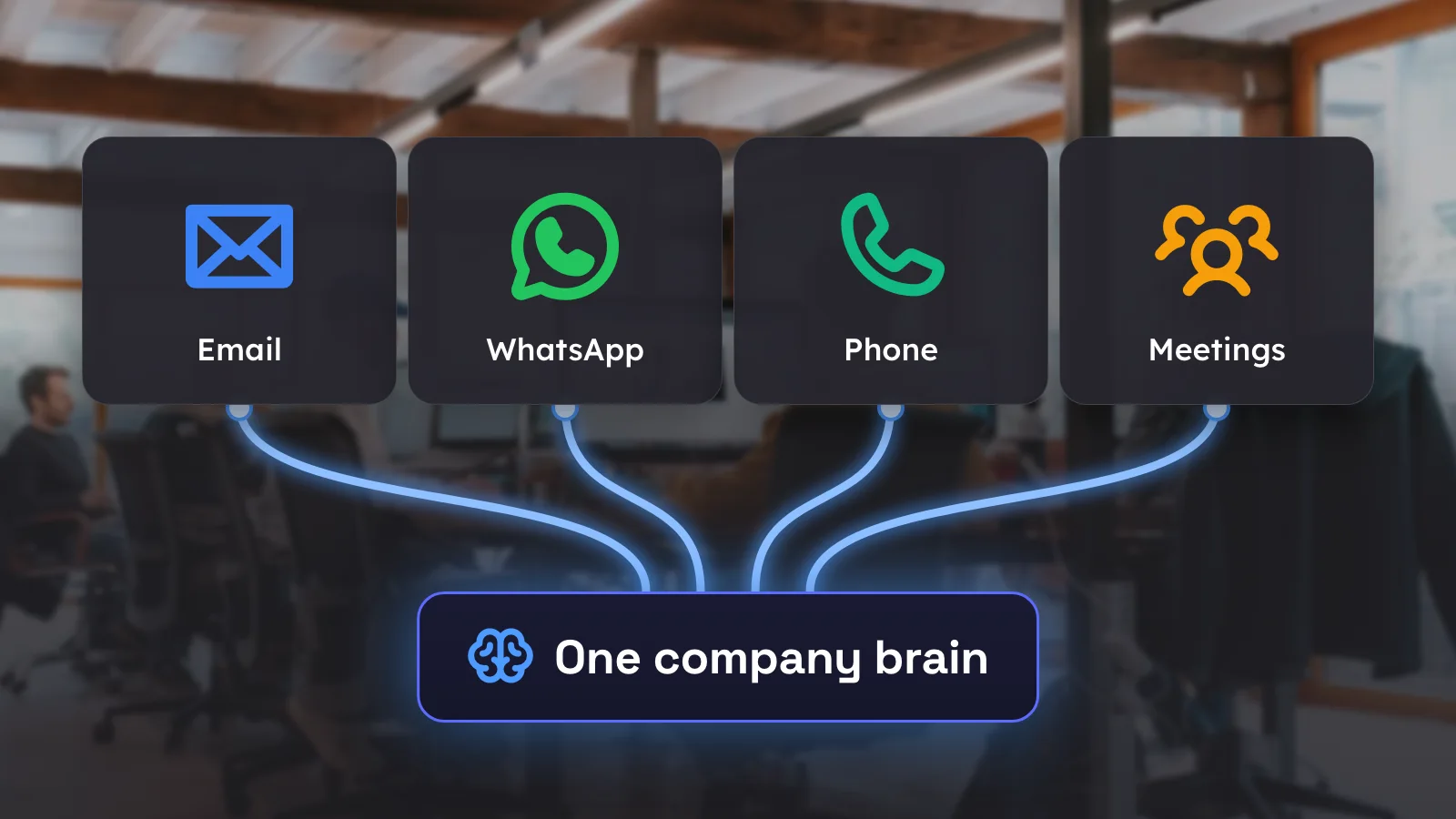
- A searchable index for email, files and meeting notes. These are stored in small pieces, so AI finds the right piece immediately instead of searching your whole mailbox every time.
Your reports also run on that copy, no longer live on your ERP. That way your ERP doesn't slow down when someone runs a heavy report.
Writing always goes through the source
AI never changes the copy. A change goes through the integration to the system where it belongs: an order in the ERP, a status in the CRM, a draft email in Outlook or Gmail. That way the source remains the system that counts, with its own checks. The change then flows back into the copy by itself.
Writing needs rules that reading doesn't:
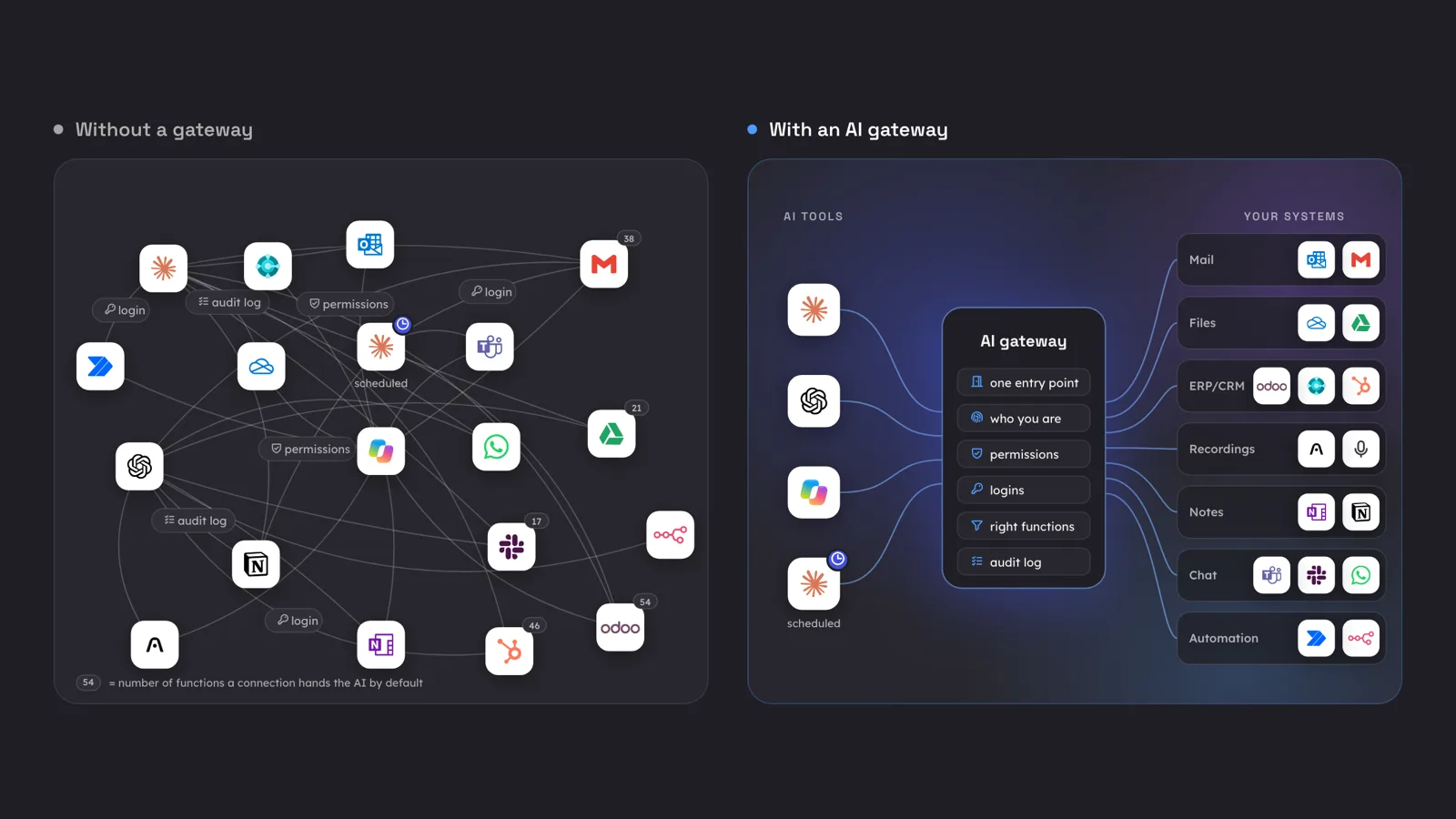
- Permissions per user and per action, through the Microsoft or Google account everyone already has. A buyer can do different things than a salesperson.
- Approval where it matters. AI proposes, a person confirms. A status can change automatically, a price or an order cannot.
- A log of every change: who, what, when and through which question.
- One entry point for everyone. Reading and writing go through the same AI gateway in the European layer. No separate connections per employee that nobody can keep track of.
What does it bring you?
Whatever happens in the US,
your data stays available.
- Your data is always yours, independent of the US. The copy sits with a European provider and is not subject to US law. If an American provider cuts you off, you still have your customers, orders, email and files in your own hands, up to the last sync. More on that in What is the CLOUD Act?
- You choose your AI model. Claude, ChatGPT, Copilot or Gemini, and for simple tasks perhaps Mistral later on. Switching is possible without rebuilding everything.
- You are not tied to one supplier. Your own code, standard databases and open formats. If you want a large analytics platform later on, the copy feeds that platform. You throw nothing away.
What it doesn't solve
The original stays with Microsoft or Google. For your email and your ERP, nothing changes with regard to US law: if you want more control there, you have to replace those systems themselves. And the AI models with the best quality are American today. With those, we ask for agreements under which nothing is stored or used for training, see EU hosting and zero retention.
A copy of your email also contains far more personal data than your ERP. So agree up front which mailboxes go in, how long you keep the data and who can search it. What the law says about that is in AI that listens in, reads your emails and answers them.
How do we do it?
At Sevendays we work this way ourselves. Our email and files are at Google, and Claude searches a searchable copy of our emails, meetings, calls and tickets. For clients we build that layer with our own code and standard databases, so you can always leave. If you want it fully European, we put it with a European provider such as Hetzner or OVHcloud, with no American party in between. How far you go is your choice.
Where do you start?
Pick one question that takes a lot of manual work today. For example: which purchases are too early or too late when you combine forecast, stock and open orders? Build the copy for that question only, let AI only read at first, and test with a small group. If it works, expand. Not sure where it would pay off most for you? Feel free to ask your question below.